文藻小螺絲釘 WUTH
柬埔寨線上華語課程: 開課前技術測試與相見歡 (撰文:季慕華)
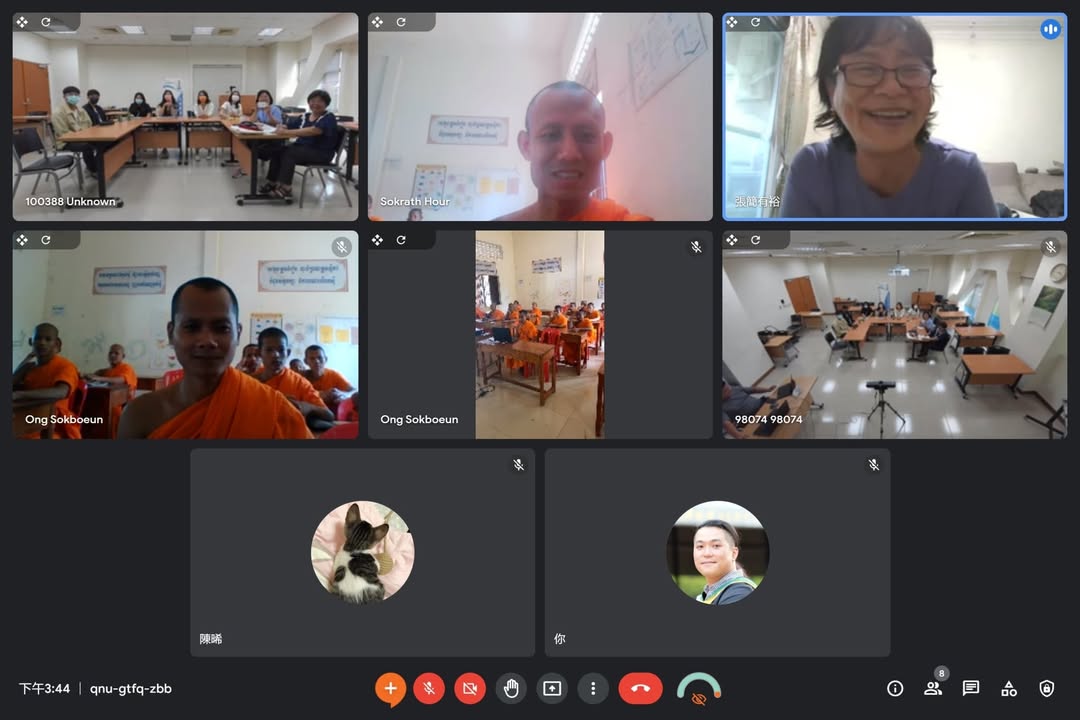
[2022/03/16,高雄季慕華撰稿] 柬埔寨華語線上課程即將於3/23正式開張,在台灣的華語小老師們歷經寒假和開學數週以來的密集準備,各個摩拳擦掌準備就緒;另一方面,柬埔寨學生也期盼已久躍躍欲試,這是他們第一次學外語,和外國教師遠距學習。本日安排雙方先做技術性接觸,實地測試視訊軟體,包括當地學校內和個別老師的遠距教學設備,務必使下週的正式上課一切順利。Green Umbrella 創辦人Sokrath Hour法師和班主任Ong Sokboeun 師父特別致詞感謝,並說出對這個班的期待,學員定會努力學習,懇請老師把他們「帶出去」開拓新視野,這正是教育education (e=out 出去, ducat=lead帶領)的本意。
目前柬埔寨目前已招募好學生,為了優化學習效果,將原來的20人降到共10人,分為兩班,每班各五名學生,加上一名跟課老師。學生主要是來自公立學校,是一群出家修行的小菩薩,個性靦腆,較少接觸外人,但喜歡閱讀,對華語學習非常積極。由於當地線上學習資源有限,因此學生將聚集在實體教室,一起上課,每班利用兩台筆電觀看螢幕播放出之畫面和教材,使用視訊軟體與老師互動,和透過社交軟體提供教材和語音檔。此外,文藻團隊並安排精通柬埔寨語的徐維良老師翻譯,適時提供協助。
文藻方面,師生聚集會議室模擬上課情境,首先由廖俊芳教授Melody主持,進行簡單互動,了解雙方在教學現場需求,讓雙方熟練操作。然後教學團隊郭沛岑組長介紹任課的小老師團隊和課程概要,並且在林建勳教授指導下,小老師立即商討並調整授課方式和學習效果。就教室內的布置方面,柬埔寨方面果然絲毫不落人後,立即調整成和文藻小班教學一樣的ㄇ字型座位,兩間教室內筆電也馬上就位,他們積極的態度和行動力令人刮目相看。因為小老師往後必須在個人使用的環境下,分別進行教學,所以特別由經驗豐富的團隊助理李世國Amos和林思如Jollis指導,處理設定和相關技術問題,以呈現最佳的效果。本團隊之英語課程已執行兩年,歷經不斷磨合和修正,達成相當優異的成效,華語課程則為首次執行,感謝雙方團隊之師生提供寶貴的經驗和提攜,彼此皆能跨越技術和文化距離,為國際志工服務和語言學習達到最佳的效果。誠如廖俊芳教授於會議結束時所說,這是施比受更有福的成長歷練。
The Online Chinese Program for Cambodia: A Technical Contact Before Class Begins (By Mu-Hua (Yolanda) Chi)
(March 16, 2022, Kaohsiung; written by Yolanda Chi) The online Chinese program for Cambodia is about to start on March 23. After weeks of intensive preparation since the winter vacation, the student teachers of Chinese in Taiwan are getting ready with their hands full of teaching materials. On the other hands, Cambodian students has been expecting the day in great excitement as this is the first time for them to learn a foreign language and the first attempt of distance learning from foreign teachers. This afternoon (March 16, 2022) a contact between the two sides for technical tests was arranged to try out the video-conferencing effects and equipment check, including the sites on campus and teachers’ individual sites, all for the purpose of conducting the program smoothly, which formally starts next week. Venerable Sokrath Hour, Founder of Green Umbrella, and Master Ong Sokboeun, the director for this class on the Cambodian side, especially gave remarks to show their appreciation for all the efforts and expectations for this class, ensuring that students would be fully devoted to learning and requesting the teachers to “lead them out” to a new vision—fulfilling exactly the goal of “education” (as in Latin “e” means “out” and “ducat” means “to lead”).
Students in Cambodia have already been recruited and to enhance learning effectiveness, the number of students has been reduced from 20 to 10. The program will be conducted in two classes, each with 5 students and a local teacher. These students are mostly from the public schools, and they are a group of young Buddhist monks, aged between 14 to 17, shy in character but fond of reading and aggressive in learning Chinese. As online learning resources are rather limited, students will gather in real classrooms, with two laptop computers in every class to show teaching materials, while teachers interact with them through video-conferencing and provide handouts or voice files using social networking apps. In addition, with highly proficient translation between Chinese and Cambodian languages, Ms. Wei-liang Xu will timely assist the classes in communication.
On the Wenzao’s site, faculty and students gathered in a conference room to simulate the teaching scene. Professor Melody Liao initiated interaction to mutually understand the needs at the teaching environment and helped teachers to familiarize with the online teaching scenario through simple practice. Then Ms. Vivi Guo, the leader of student teachers, briefly introduced the teaching force and the course plan. With Prof. Johnson Lin’s advice and guidance, modification was instantly made for instruction and the expected learning outcomes. In terms of the classroom layout, the Cambodian side soon picked up the idea and did not waste time in rearranging the seats in U-shape, meeting exactly the way of instruction as a Wenzao class of small size. Also, two classrooms with laptop computers were in place within just a few minutes. Wenzao faculty and students were deeply impressed by their positive attitude and mobilization. As the student teachers were going to instruct the class on their own computers, Amos and Jollis, our assistants, offered their precious experience and helped with setting up and solving related technical problems in order to present the best effects. The English program of WHC-USR has been operated for two years and has achieved excellent outcomes after numerous times of trial and error, and modification. For the Chinese program, this is the first attempt. Here we offer our sincerest gratitude to all the faculty and students on both sides for their precious experience and support, enabling each other to cross over the technical and cultural boundaries for the best effects in international volunteering and language learning. Just as Prof. Melody Liao mentioned at the end of this technical encounter, this is a process of growth, in which “it’s more blessed to give than to receive.”