文藻小螺絲釘 WUTH
愛在柬埔寨,防疫不停學 撰文:邱珏綾、楊靚紋、 邱怡靜老師
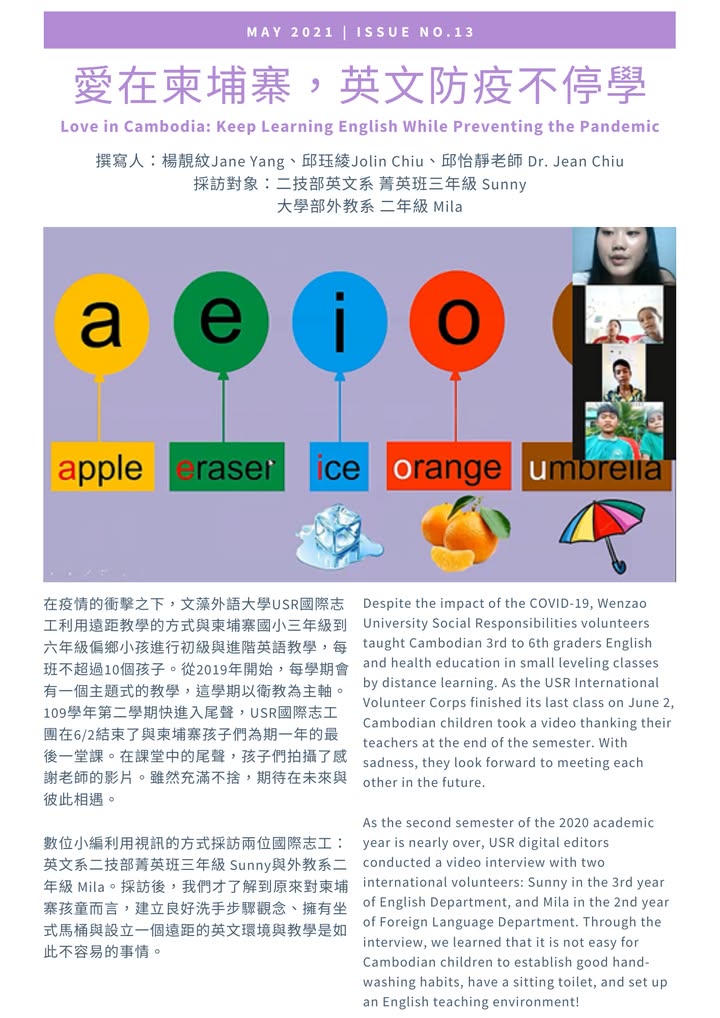
在疫情的衝擊之下,文藻外語大學USR國際志工利用遠距教學的方式與柬埔寨國小三年級到六年級偏鄉小孩進行初級與進階英語教學,每班不超過10個孩子。從2019年開始,每學期會有一個主題式的教學,這學期以衛教為主軸。109學年第二學期快進入尾聲,USR國際志工團在6/2結束了與柬埔寨孩子們為期一年的最後一堂課。在課堂中的尾聲,孩子們拍攝了感謝老師的影片。雖然充滿不捨,期待在未來與彼此相遇。 數位小編利用視訊的方式採訪兩位國際志工:英文系二技部菁英班三年級 Sunny與外教系二年級 Mila。採訪後,我們才了解到原來對柬埔寨孩童而言,建立良好洗手步驟觀念、擁有坐式馬桶與設立一個遠距的英文環境與教學是如此不容易的事情。以下是小編與兩位國際志工訪談的Q_A精華片段: Q:在教導柬埔寨孩童英文時有遇到什麼問題嗎? A:在教學上遇到的困難可以分為備課期間與教學當下的困難。在選擇題材上,首先須了解柬埔寨當地的文化背景、生活環境。例如:在柬埔寨村落中,沒有我們習以為常的坐式馬桶。若是志工們只考慮到自己想上什麼內容, 傳授給孩子們的內容也是沒有效益的。教學當下的困難點則是當地孩子們的口音問題: 用英文教英文,對當地的孩子來說是一項巨大的挑戰。在口音方面他們有時會彈舌、音調會與我們所學的英文不同。 此時,盡力教導、不侷限孩子的發音是很重要的一件事。
Q:有什麼讓你印象深刻或感動的事嗎? A:每個老師在課程結束後,都會跟孩子們說聲:I love you,他們也毫不猶豫而且真心誠意的回我們I love you too. 彼此的互動很溫暖可愛讓人難以忘懷!在教育資源相差懸殊的狀況下,或許對我們來說簡單的洗手觀念,對他們來說是個從沒想過的知識。受訪者Sunny告訴我一堂令她印象深刻的課,當孩子在進行遊戲時,因為玩遊戲玩到走火入魔而站起來尖叫加拍手。同時她也跟著孩子們尖叫加拍手,彷彿朋友一般。 原來,教育與愛,是不分國籍,不分程度就能散播到各地的! 也因為每一次的感動,漸漸讓她確信自己走在正確的道路上,回饋這個社會。
Q:參加完USR國際志工團的活動後,你的心態有什麼轉變嗎? A:價值觀上有了很大的轉變,更加珍惜現有的學習資源和環境,當在學科上面臨到什麼問題時,腦中都會浮現孩子們的學習樣子和這半年多來我們相處的點滴,就會覺得他們都可以抱有每個學習機會,我們也要有這樣的態度!並且清楚的知道, 我是一個能夠用自己的專業發揮影響力的人! 未來,想繼續用自己的能力教導與幫助不論是國外或國內的村落孩童們,只要在我的能力範圍內能回饋社會的活動,我都會參與!
Q:若想參與USR國際志工活動,需要具備什麼樣的人格特質或能力? A:國際志工的特質就是有愛心,大家都不求回報。在籌辦活動或者討論教材時並不會有任何利益關係,深刻感受到善良的大家都是為了相同目標而努力。
從與兩位志工的訪談之中,可以看見他們對於偏鄉教育的積極以及外語教學的熱情。期待在未來還能有更多的USR計畫投入在優質教育當中,實現SDG4優質教育的目標。
Love in Cambodia: Keep Learning English While Preventing the Pandemic
By Jolin Chiu, Jane Yang & Dr. Jean Chiu
Despite the impact of the COVID-19, Wenzao University Social Responsibilities volunteers taught Cambodian 3rd to 6th graders English and health education in small leveling classes by distance learning. As the USR International Volunteer Corps finished its last class on June 2, Cambodian children took a video thanking their teachers at the end of the semester. With sadness, they look forward to meeting each other in the future.
As the second semester of the 2020 academic year is nearly over, USR digital editors conducted a video interview with two international volunteers: Sunny in the 3rd year of English Department, and Mila in the 2nd year of Foreign Language Department. Through the interview, we learned that it is not easy for Cambodian children to establish good hand-washing habits, have a sitting toilet, and set up an English teaching environment! The following are the highlights of the interview in a Q & A format:
Q: Have you encountered any problems in teaching English to Cambodian children? A: The difficulties we encountered in teaching can be divided into difficulties during the preparation period and difficulties at the moment of teaching. The first thing we need to do is to understand the cultural background and living environment of Cambodia. For example, in Cambodian villages, there are no sitting toilets that we are used to. If the volunteers only think about what they want to teach, it will not be effective to teach the children. Another difficulty in teaching is the accent problem of the local children: teaching English in English is a huge challenge for the local children. They sometimes have a different accent and accent tone than the English we have learned. It is very important to try to teach the children without limiting their pronunciation.
Q: Is there anything that impressed you or touched you? A: Each teacher would say “I love you” to the children at the end of the class, and the children didn’t hesitate to say “I love you” back to us. The interaction was so warm and loving that it was unforgettable! With the disparity in educational resources, perhaps the simple concept of hand washing to us is a knowledge that they never thought of. Interviewee Sunny told me about a lesson that impressed her when a child was playing a game and stood up screaming and clapping because he was so caught up in the game. At the same time, she also squealed and clapped along with the children, as if they were friends. She realized that education and love can be spread everywhere regardless of nationality or level! And because every time she was touched, she is convinced that she is on the right path to give back to the community.
Q: How has your mindset changed after participating in the USR International Volunteer activities? A: There is a big change in my values, and I cherish the learning resources and environment more. When faced with any problem in the subject, the children’s learning style and the time of our relationship over the past six months will appear in my mind. They can have every learning opportunity, why can’t we have this attitude. I know clearly that I am a person who can use my profession to make an impact! In the future, I would like to continue to use my abilities to teach and help children in foreign and domestic villages, as long as it is within my ability to give back to the community, I will do it!
Q: What personality traits or abilities are required to participate in USR’s international volunteer activities? A: The trait of an international volunteer is to have a loving heart and to not expect anything in return. There is no interest in organizing events or discussing educational materials, and there is a deep sense of goodness that we are all working towards the same goal.
From the interviews with the two volunteers, we can see their enthusiasm for rural education and foreign language teaching. We hope that more USR programs will be invested in the future to achieve the goal of SDG4 quality education.